Vikas Kamat is a programmer- entrepreneur
living
in Atlanta. This blog is a complex mix of Indian
culture, life in southern USA, computer sciences, and sports. Opinions are his
own. About - Bio - Contact
Computing, Libraries, Tennis, India & other interests of Vikas Kamat
Computing with Tags
I am happy to add a new "Browse by Tags" feature to Kamat's Potpourri.
We have internally supported tags from 1997 (we called them CrowWords, a mock of keywords, after my company CyberCrow), but they were designed for machine-learning rather than for humans.
Anyway, the addition of tags in addition to keywords and crowwords gives us a rich content platform classify and organize the website.
It is indeed fascinating to see the disparate content items come together.
It is wonderful if you have the luxury of human-tagged contents (like Flickr, Technorati or Delicious have). But what if your content is not already tagged?
That's when Keyword Extraction comes into play. We had implemented a rudimentary extractor for our -- if a letter was capitalized, it was given a weight and a tag was started. I don't have any research or study on how effective it has been.
Then Yahoo introduced an Extraction API. In my experience, it is a wonderful service (if you can tolerate the 503 s it seems to throw often), and we have supplemented generated tags whenever human-provided tags were not available. I had to make much tuning, because most of the tags Yahoo suggested had "kamat" or "india" in them. But this automation allowed us to gather some 192,000 unique tags!
After gathering the tags, I build a matrix to view the tag density. This exposes both the strength and weakness of our contents, and helps in generation of Tag Clouds.
Generation of Tag Clouds
The coma delimited tags are transposed into rows using SQL and are ranked based on repetitions. The physical proximity is weighted in.
Having all this infrastructure, the generation of a Tag Cloud is then simply querying the database with various SELECT clasues.
Kamat's Konkani book "Konkanyali Kavikala" is being reprinted by
the Goa's Konkani Akademy. The text is being revised so the people of Goa
can understand the technicalities of the book. We don't quite realize, but
the Konkani spoken in parts of Karnataka has so much Kannada verbs in it
that Konkanis elsewhere cannot understand it!
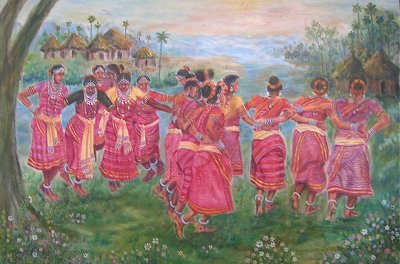
Marathi Koligeet
In Appreciation of Marathi Koli Folksongs
In our joint-family, many of the elders studied in the erstwhile Bombay
Presidency and knew Marathi very well. The Antakshari games my aunts used
to play when I was young were invariably in Marathi, and I know lots of
Marathi folksongs, theater songs (Natyasangeet), and devotional songs (Bhaktigeet).
During a recent road trip to Chicago, Milwaukee and back, I happened to carry
a CD of Marathi folksongs, known as Koligeet, or the songs of the fisher-folk,
and the music took me to my childhood.
All the songs in Koligeet are set in the background of river, sea, storms,
and other coastal artifacts. The songs feature melodious tunes, playful themes,
teasing, and innocence of a lifestyle that is lost since. Each song has a repearting rythm that reminds of the waves in the sea.
If you have never heard it, and know even a tingy bit of Marathi or Konkani, I encourage you to discover the Koligeet music. Lata Mangeshkar and Asha Bhonsle have sung many Koligeets, and I'm sure you can find them online.
Several Bollywood songs have been inspired by Koligeets, but I haven't heard even one that lives up to the beauty of the originals.
Some of my favorite Koligeet songs: • me dolkara dolkara dariyata raja sung by Lata Mangeshkar and Hemant Kumar • disalaga bayi disala sung by Asha Bhonsle • badala waro sutalago
The Saga of Tibet
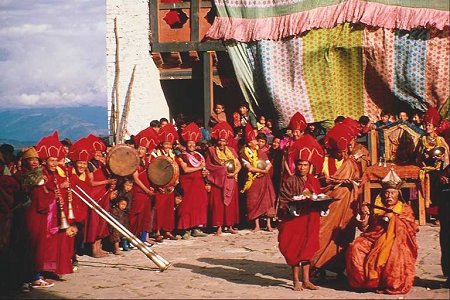
American journalist Lowell Thomas Jr. visited Tibet (then a mysterious, but free nation), in 1949 with his father and met Dalai Lama (then a teenage boy). They were the 7th and 8th Americans in the history to be granted this privilege. Thomas's 1950 book "Out Of This World - across the Himalayas to forbidden Tibet" contains rare and important photographs of period Tibet, before its collapse in 1959.
I got an angry email from a patron today. I have no idea why I was chosen to register this protest. I am reproducing it below.
From: Papinda Singh
I have read on the BBC website that Kannada's writers are opposed to the teaching of English in schools for children younger than 11.
I have to say that is the most ridiculous, idiotic and cruel campaign I have every heard of. How dare you stop children from opportunities they richley deserve. I hope the same lack of consideration you are displaying to the children of your state is displayed to you.
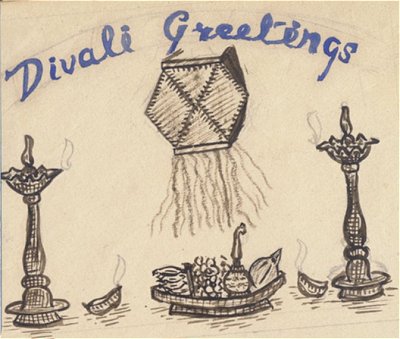
My greetings to all readers of this blog on the occasion of the Diwali (spelled differently as Diwali, Divali, Deewali etc, as I have pointed out in Trouble with Indian Names)
My family rarely bought greeting cards. My dad and I would make them by hand. No two cards we made were alike, so I don't remember what card we sent to whom.
I was never as good as Bappa, but I am surprised that many people kept the cards I sent decades ago, as tresured items.
I found no equivalent word for the Konkani word poasth in English. Poasth is something you collect over years that you pay no attention to; it's part valuable, part junk. I am using the word daftar in the same way, although I am not sure it means the same thing. Definition in Hobson Jobson Dictionary.
Epilogue 2
One man's junk and another man's treasure. Sometimes I wonder what my daftar is worth; because I myself keep finding treasures in it all the time! Letters of famous people, autographs, unidentified group photographs, and collectibles.
In a courageous and dramatic move in 1975, Shivaram Karanth returned to the Government of India, one of the nations' top most civilian honors bestowed upon him.
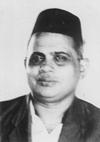
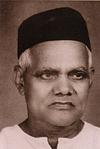
Two rare pictures of members of original "Geleyara Gumpu" that played a key role in Kannada rennaisance: Prahlad Naregal and Govind Chulaki.
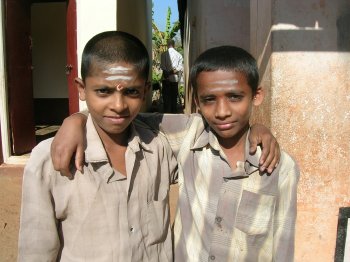
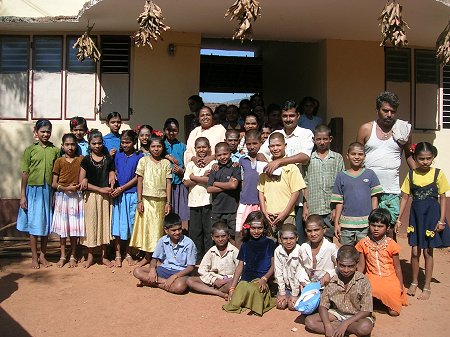
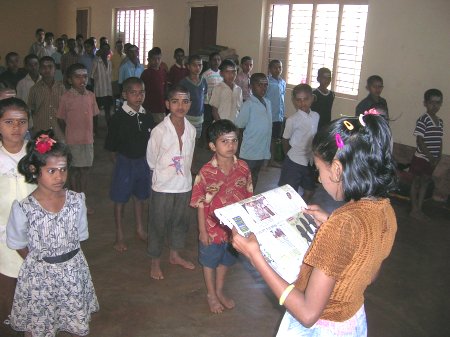
Visit to Dayanand Ashraya Dhama
In 2005, I had an opportunity to visit Sri Swami Dayanand Ashraya Dhama, a
shelter for young children run by seer Chidrupanand Saraswatiji. It was a
touching experience, just due to the way the shelter is operated in the most
minimum of resources, and the enthusiasm and spritely health radiated by the young residents.
It is amazing what cultural transformation awareness and networking can bring about. Remember Amma's Konkani book that I complained so much about? That book went out of print in no time, and second edition is also not available due to limited number of copies commissioned.
The popularity of the book (and a show based on the book by Anuradha Dhareshwar) led to conducting of a workshop to teach housewives some of the songs, so they could sing them at weddings they attend. That was very successful, because the ladies who attended the workshop were in great demand to bring some of the old-glory value to weddings.
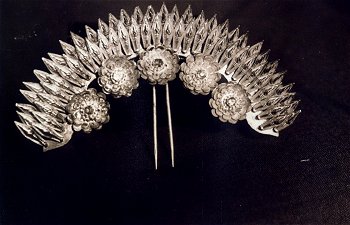
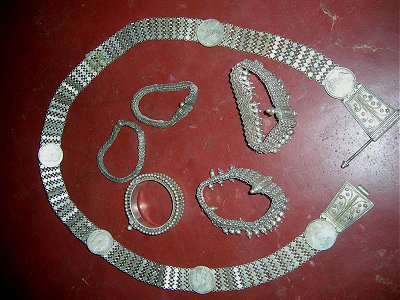
One of the songs on the CD describes the glory of the jewels worn by the guests at a wedding. Most of this jewelry art is now lost, but the songs introduce us to the lost art form. When I see some of these jewelry in museums or with collectors, that I realize that the jewels described in the song is a real one, and I begin to admire the beauty of oral traditions of India.
For those who don't know, India had a strong oral tradition of imparting knowledge on history, arts, grammar, and mathematics. A lot of people don't get it, and just because someone is illiterate (one who can't read or write), they are condemned as ignorant. They aren't the same thing.
Konkani language may not have a script, but that doesn't mean it has no literature.
Powered NOT by Blogger or MovabaleType or
WordPress, but by SimplyBlog, a software I wrote to
create blogs.
See details
of implementation or download SimplyBlog.
This is how I surf the web. Turns out
creating your own start page beats all portals, back-flipping,
personalized corporate pages, and book-marking tools.