Vikas Kamat is a programmer- entrepreneur
living
in Atlanta. This blog is a complex mix of Indian
culture, life in southern USA, computer sciences, and sports. Opinions are his
own. About - Bio - Contact
Computing, Libraries, Tennis, India & other interests of Vikas Kamat
Truth as a Religion
Truth as Religion
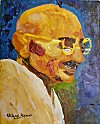
Today is Gandhi's Birthday.
I am very much drawn to the school of Hindu thought that worships Truth as God, that Gandhi advocated. Truth is not same as reality; truth is what you discover when you see through the reality and the myths.
Gandhi and Slavery
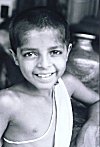
This month's National Geographic has a graphic stories of 21st Century Slaves, many of them set in India. The intensely personal editorial of the issue talks about how the reporters went back to their car and wept at the plight of a boy in Kancheevaram. I am so glad we have a periodical like National Geographic, that seeks truth, whether it is pleasant or not. In fact, the truth presented in this article is very unpleasant and disturbing. For me, what is equally disturbing matter is when Indians attack the story writers and publications everytime an unpleasant piece is written about India.
I revere Gandhi, because he had a plan. A plan to liberate the 20th and 21st century slaves --untouchables, tribals, Gypsies, working children, and prostitutes, and all-- not through law-enforcement, but though social reform and changing of hearts. His Sarvodaya movement involved comprehensive development of India, with all the segments of the society advancing equally, and simultaneously.
Gandhi's agenda has long been broken in India, and elsewhere, and probably it is now unwise to go back to his social program verbatim But till another great man of the stature of Lincoln or Gandhi rises, we have to lament on the path of wisdom not taken.
The writer, Velany Fernandes, briefly spoke to me about some of the issues. Excerpts:
What are the Indian/ Indic/South Asian texts/resources available at your site?
While we do not have any complete ancient texts available oat Kamat's Potpourri,
we have a number
of manuscripts, epigraphs, and inscriptions from various time periods of Indian history. In addition
to classical texts, we have a huge collection of common artifacts.
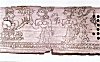
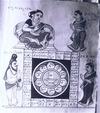
Specifically, we have pictures from illustrated manuscripts of Shivattwanidhi, Ragamalika, Shivapurana,
Sougandhika Parinaya. We also have digitized pages of many palm-leaf texts.
How did you avail these texts and make them available online?
As researchers, my parents had access to some of these rare manuscripts, and my father had
photographed them from museums, university archives, and private collections. We have a systematic process to publish them on the Web.
Technology is often accused of taking present generations away from their
ancient texts/culture. How do you think this kind of technology can help bring ancient texts/culture
to the present generation?
Today's generation is losing interest in Indian culture not because of technology,
but because of lack of their interest in it.
I do not think that digitizing ancient texts will arouse interest in Indian heritage.
I have to get up at 5 o'clock in the morning to go to bathroom. I wake up the Kamats by a soft yapping. My family
tells me as I grow older, my bladder will enlarge and they will be able to sleep
their normal hours.
Then I listen to latest news on National Public Radio, and
wait for mommy to give me breakfast. I enjoy eating my breakfast wiggling my tail, while sitting on the
lap of daddy or mommy.
Then I take a walk and take care of unfinished early morning business.
Puppy Toothpaste
I must thank those writers who write these "How to Raise Your
Puppy" books. According to the books, my folks never punish me. They really
try very hard to give me what the writers call a stimulating environment.
I am exposed to different kinds of music (from Beethoven to Hariprasad Chaurasia
to Country music), different kinds of colors, different smells, and different
people. The Kamats seem to think that my brain stops growing after the
third month, so they are trying to jam-pack all the knowledge right now. To be
honest with you, it sometimes gets too much for me.
My Best Friend and I
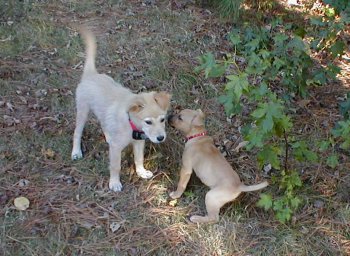
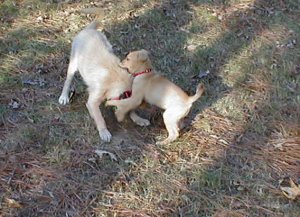
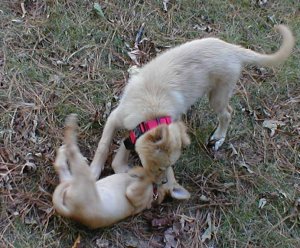
My favorite part of the day is when I play with Barkley, my neighbor. He is a
much bigger dog, and just because he has a penis he thinks he can bully me, but
he is badly mistaken. He just needs to mature a little. Barkley and I play high-contact, and I get very tired after playing with him, and need to drink a lot of water and rest.
I get lunch and a small walk in Kamat yard during noon. If Barkey is
available, I play with him again.
In the evening, if one of the Kamats is playing a tennis match or something,
I go to the tennis courts and distract the opponents with my cuteness. Usually
there are many boys and girls who want to take me home, and I enjoy all the
attention they give me.
Then I hang around the house, watching TV or surfing the web. Sometimes I
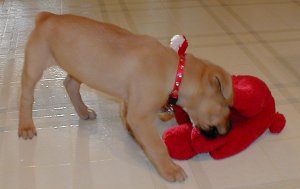
take a nap before the dinner, or sometimes I play with my toys.
Colorful Toys Stimultae My Brain
After dinner, I go out one more time, looking for idle squirrels, slow
rabbits, or deer. I like to chase them even though I would not know what to do
if they didn't run.
After a full-day's activity I fall asleep. Sometimes I hear my parents
discuss whether they should let me sleep on the master-bed with them. I am eagerly looking forward to that day.
Amma's Pilgrimage
Amma's Pilgrimage
Amma (my mother) is on a pilgrimage to some of the holiest of the Hindu shrines and cities till October 21st. She will travel from Bangalore to the slopes of the Himalayas to Badarinath, Hardwar, Kedarnath, Brindavan, and Hrishikesh.
It is a journey I'd like to take someday. Not so much for the religious aspect, but for the awe-inspiring historical and traditional reasons. It is the pilgrimages like these that have kept India as a nation together for thousands of years -- how else could a country where cultures, languages and living habits were different, could exist as one nation? Except these holy centers, what else is common between my grandma, a housewife in the town of Honavar, and a housewife in Rajasthan?
During the long pilgrimage, Amma will travel by train, bus, car, horse-carriage, and even palanquin-like bovis, and will cover a thousand miles. Wow!
Last week, along with some of my friends, I donated money to Udavum Karangal, a great charitable organization run by selfless volunteers in Tamilnadu. This week I am donating to United Way. Both my donations were encouraged and matched 100% by friends, and I thank them for thier generosity and leadership.
I believe that volunteering and donating money is a civil duty. I think that we all must make some sacrifices so others can have a chance.
Today, Tintin my puppy, went to school. Since she is too young, she was not allowed to sit in a group class, and had to take private tutions. Of course, the school also sells its own academic supplies, and text books for parents. After this elementary class, she will also take intermediate, and advanced lessons. It's hilarious.
It's also very expensive, and troubles me deeply if such extravagance is appropriate.
Then I always find solace in Shivaram Karanth's famous words during the first World Kannada Conference in Mysore (year 1985; I was in college and was in the audience).
1985 was a bad year for the farmers in Karnataka and there was wide-spread drought. A lot of people (including me) at that time felt it was unwise to host a cultural conference or engage in celebration, because the cattle were dying and there was no water.
As Shivaram Karanth inaugurated the conference, a number of people stood up and protested the holding of the cultural conference. Dr. Karanth had said in his characteristic style --"I know there is a drought, a severe drought. And I want to ask how many of you have stopped watching movies because there is a drought. I want to know how many of you have stopped eating spicy pan-cakes (masale dosa) because there is a drought."
Of course, Karanth was a genius. He put it so well. Not having the cultural show did not mean there was going to be rains, or prosperity. Similarly, not sending my puppy to a pricey dog-school does not mean poor children elsewhere would have benefited.
In my village in India, there was this poor artist, who, whenever someone asked him "How's Life?", he'd always say "Oh, what can I tell you? My house is full of kids, and my yard is full of shit!"
As kids, we thought it was funny -- he was a poor man and did have six or seven children, and did not have sewage or a sceptic tank facility.
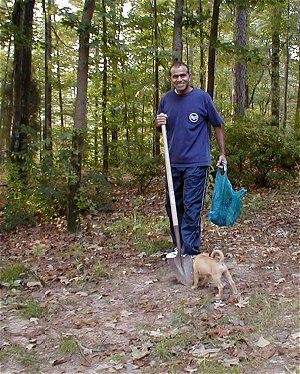
Now, I remember the artist every morning as I pick up after TinTin.
Librarians and Programmers
Librarians and Programmers
Dave Winer says he likes making software for librarians (link)
I like making software for users of libraries. I do it for a living.
I work a lot with librarians as well as geeks. Someone(probably a
librarian) somewhere thought, since both librarians and programmers work with
information, they must be related, and must work together. But as my notes based on working with
either, tell you, they are quite different groups that quite don't get along.
Librarians are typically female, typically are well read, have good English language skills, and typically underpaid. The programmers are typically male, typically have poor writing skills, spell poorly, and are
overpaid.
There is a tremendous collide of nomenclature. What the humans call a book, the librarians call a monograph. What we call a periodical, they call a serial or a title. A database system for a
geek means a relational database management system, for a librarian it means
a collection of citations. I am not talking about some individual making a
mistake, I am talking about two large white-collar, vertical industries. For
a geek, Oracle is a database. For a librarian, ProQuest is a database.
Librarians are nit-pickers. They get very frustrated (who doesn't?)
because the programmers won't listen to them. Unfortunately what librarians
don't get is that some of the programmers have sound mathematical
foundations in their brain, and can organize the information much better for
easy retrieval, than the librarians can. The librarians refuse to accept
that programmers get organization of information. Just look at the
LCC Classification
System, which is like holy grail for librarians. Medicine is not under
Science, and Military and Naval Science are in the same hierarchical level as
Music. Categories E and F (History of America) are actually same! How can a
programmer respect these?
Librarians feel threatened by systems like Google. Their gut feelings
are right. Do you know how many people walk to a library and use Google? And
you know what, Google is pretty darn good at finding what a user (patron)
want whereas a library is not. Just consider how painful it is for a patron
to access the electronic versions of a licensed journals-- first you have to
register your IP, then you have to get a login and password -- a different
one for each of the e-journals the library has subscriptions, it is a
nightmare. No wonder library usage is declining worldwide.
This is not a criticism of librarians as a profession. If you are
offended, please read some jokes ridiculing the
programmers. IMO a
librarian's job is more honorable than a programmer's, and I say that just
because of my upbringing as a Hindu which gives a lot of credit to the
knowledge professions like teachers, gurus, sages, and librarians.
Mukta Venkatesh is No More
(via Instant Message from a relative, link to news)
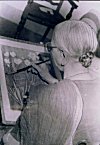
Mukta Venkatesh, the talented painter of flowers (see: ) passed away yesterday. She was 101.
I've known Mrs. Venkatesh since I was a college student in Mysore, and we were very fond of each other. I have been greatly inspired from her personality, her mastery of English poetry, her affection, and desire to continue her hobbies.
Goodbye Muktamma, and thanks for all those hand-painted floral greetings you sent us.
BAFFLE-Bash Tonight!
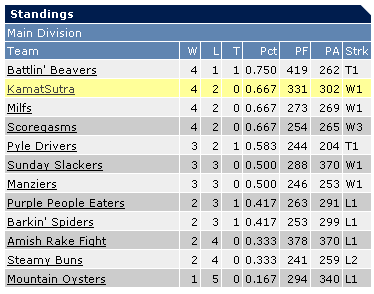
The Birmingham Area Fantasy Football League meets for a bash tonight at "On Tap Sports Cafe" to watch Chiefs visit the Raiders.
Say Hi if you see me.
BTW, my franchise, The KamatSutra has done very well so far. For the Monday Night game, I am behind by 10 points, but still have Priest Holmes.... Should be a great contest..
What Inspires Us?
Inspiring Persons
Amma (back from her pilgrimage to the Himalayas, via telephone): "I consider fortunate to have met such towering personalities like Mukta Venkatesh, R.K. Narayan, and Chaduranga. They have enriched my life so much!"
While I don't think of it often, I have been truly priviledged to meet many great men and women. The voluntary organization RSS, where I was a cadet during the 70s, was full of men of great personal character and descipline. Being born to academic and intellectual parents meant that I frequently came in contact with writers, poets, scholars, and artists. Most of my father's customers in his Scientific Photo Lab had PhD.s, and were devoted servants of science.
People inspire others not just from their knowledge or attitudes, but also from intrinsic human qualities, like courage. My father, for instance, was greatly inspired by the misery of life. The way poor folks fight through life's harsh realities excited and inspired him, and that inspiration can be seen in much of his works.
Opportunities in Invisible Web
Opportunities in the Invisible Web
Invisible Web (a.k.a. Deep Web) is the galaxy of documents that are not
accessible through open search engines like Google. Examples are authenticated
content, non-textual content, and custom content. By some estimates the
Invisible Web is already fifty times bigger than the World-wide Web.
Just the very nature of the Invisible Web -- need to keep the data private --
makes centralized computing impossible. This means that there are lots of
opportunities for low-cost search engines, and low cost subject directories, and content management systems.
I think that most tech. companies are too much focussed on the visible web, and not so much on the Invisible Web. I am interested in talking () to engineering types who are plumbing the Invisible Web.
Documenting the Undocumented
Documenting the Undocumented
Those who grow up on India's west-coast are very familiar with a Konkani speaking community called Kudubis. They are a fun loving tribe, and most popular for their celebrations of "Shigmo" (harvest festival), and "Gumatepak" (celebration of Spring) festivals. In our continued efforts to document the undocumented India, I have rehashed a 2000 article on the community and present a new section on the Kudubi Communtity.
G.B. Joshi Centennial
It is in the same spirit (documenting the undocumented, or singing the unsung) that we remember the contributions of G.B.Joshi during his centennial year, this year.
Of course, Joshi was a family friend, a mentor to my father, and was great man. His acumen to run a prestigious publishing house on a shoe-string budget was amazing (and had earned him the nick-name Fox). IMO it is only due to efforts like Joshi's that Kannada language and literature survived and prospered. What can writers do if they have no market?
After Amma's Kannada book "Nenapinalli Ninthavaru" (Those who persisted in my memory) came out, I requested her to document the lives of some of the great, yet forgotten leaders of Karnataka. As a historian, as a scholar, and as a biographer, I felt that she was in a unique position for the assignment. She obliged, and I am pleased to compile this list of biographies of many of the unsung heroes of Karnataka.
On Havyaka Brahmins
Havyaka Brahmins
A patron, Subrahmanya Bhat notes that thirty-two families mentioned in Amma's article
on the Institution of Agraharas are
the original Havyaka Brahmins. How fascinating!
He cites oral history and tradition (which is a very imporant source of information for students
of Indian history -- see an example of how
tradition was used to rebuild history), as well as some well reserached works (see Roots of Havyaka Brahmins by Subraya Hegde and Nagendra Hegde). It all makes so much sense to me.
For many years I have been asked to add more content on Havyak community, and today I have decided to add a new section on Havyaka Brahmin community under our fast growing
People of India section.
But first I have a story to tell.
The story requires some background.
In the area of India that I and my father grew up, the Konkani Brahmin community (to which I belong to),
and the Havyaka Brahmin community have a fierce social competition -- a very healthy, and natural
competition --competing for higher achievements in academics, sports, giving to charity, and in political power.
The two castes also
have a close symbiotic relationship. Some of my best friends were Havyakas (or Haveeks, as we called them).
Privately we made fun of thier language -- a very old and traditional precursor of present day Kannada,
and their impracticality (most Havyaks were priests, farmers, and teachers, whereas most Konkanis were
bankers and businessmen), and I am sure the Havyaks rediculed us as "fish eating brahmins", and "cunning Konks".
Now the incident.
Many many years ago (1970s), my father wrote an article documenting the Havyaka Brahmin community in a popular
periodical, Karmaveera. It was well received, and earned my father many fans and admirers,
and as recently as 1999 I have seen requests for its reprint. But some Havyaka leaders thought that Bappa
relied too much on hearsay for documenting the traditions, and felt some parts were demeaning to the
community. They burnt the copies of the magazine in protest, and called for boycott of Bappa's writings.
Due to the delicate nature of the matter and its potential for communal disharmony, Bappa did not respond to the
protests. When the requests for reprints were received, he denied them. It took other Havyaka scholars like
V.G. Bhat, to
befriend and support Bappa, before he would write about the Havyaks again.
In some ways, I feel
honored on being asked to build a website for Havyak community --a community with whom I lived, grew up, competed, and among whom I have so many friends.
I also feel a sense of satisfaction on seeing an old wound heal fully.
Powered NOT by Blogger or MovabaleType or
WordPress, but by SimplyBlog, a software I wrote to
create blogs.
See details
of implementation or download SimplyBlog.
This is how I surf the web. Turns out
creating your own start page beats all portals, back-flipping,
personalized corporate pages, and book-marking tools.







 What are the Indian/ Indic/South Asian texts/resources available at your site?
 While we do not have any complete ancient texts available oat Kamat's Potpourri,
we have a number
of manuscripts, epigraphs, and inscriptions from various time periods of Indian history. In addition
to classical texts, we have a huge collection of common artifacts.
Specifically, we have pictures from illustrated manuscripts of Shivattwanidhi, Ragamalika, Shivapurana,
Sougandhika Parinaya. We also have digitized pages of many palm-leaf texts.
While we do not have any complete ancient texts available oat Kamat's Potpourri,
we have a number
of manuscripts, epigraphs, and inscriptions from various time periods of Indian history. In addition
to classical texts, we have a huge collection of common artifacts.
Specifically, we have pictures from illustrated manuscripts of Shivattwanidhi, Ragamalika, Shivapurana,
Sougandhika Parinaya. We also have digitized pages of many palm-leaf texts.



 This is not a criticism of librarians as a profession. If you are
offended, please read some jokes ridiculing the
This is not a criticism of librarians as a profession. If you are
offended, please read some jokes ridiculing the
 .
.