Vikas Kamat is a programmer- entrepreneur
living
in Atlanta. This blog is a complex mix of Indian
culture, life in southern USA, computer sciences, and sports. Opinions are his
own. About - Bio - Contact
Computing, Libraries, Tennis, India & other interests of Vikas Kamat
What is an AutoBLOG?
What is an AutoBLOG?
An AutoBlog is a manufactured weblog.
Like other manufactured goods, AutoBlogs reduce errors,
increase productivity, and ensure the quality of the output.
AutoBlogs reduce reliance on people, can be cheaply mass-produced,
and consumers love them (?).
I am happy to announce the availability of Kamat's
American Travelogue (Nanoo Amarecage Hogidde in Kannada language)
on the occasion of America's birthday.
This is the 12th edition of the book, and it is available
from stores that sells Indian language books.
Many people consider Nanoo Amarecage Hogidde, Kamat's first, as his best literary work. It is
an excellent travelogue of USA of 1960s that compares and
contrasts the practices of India and America. Many readers have
written to Kamat that they learnt as much about India as they
learnt about USA from the book.
More Kamat to Come Soon
I've also heard from Prism that Kamat's book on Snakes would be out by
August of 2002.
Thanks to the laborious editing undertaken by my mother,
a compilation of some of the letters father wrote to me in the 1990s
is being made into a book "Letters to son".
This book was in fact, demanded by Kamat's admirers gathered at his
condolence meeting,
who had read his "Letters to soul-mate" -- a collection of his letters written to my mother.
It is gratifying to live up to the expectations of the fans.
The book really reads well. I look forward to its release. Meanwhile, the hard-core fans can write
to me () and avail a photocopy of the manuscript.
So by bringing out three books in four months, my father is very productive for a dead man!
Silicon India, No Longer Free
Silicon India, No Longer Free
The Silicon India Magazine, a hitherto free periodical for
Indian engineers inside the computer industry will no longer be free, the latest issue said.
I've read each and every issue of the magazine and have learnt a lot from it.
The periodical, while lacked sophistication (poor color combination in page layouts,
tacky covers, very poor proof reading of articles), acted as a hub of activity for
what was once known as the Indian Mafia (a close-knit network of
entrepreneurs and capitalists, brought together by associations of alma-mater and caste)
and the wannabe mafioso.
I have decided not to subscribe. But I will definitely miss the monthly dose of desi business wisdom.
Perhaps after seeing the pictures of my
ordaining, and some of the content on Hinduism on our site, some people take
me for a Hindu priest. Sometime ago, I got a message from alienated Hindus from
the city of Maputo in Mozambique. Apparently, Hindus there have built a
temple, but do not know how to conduct the rituals of coronation, and
installation (pratishtana). The gentleman had many questions, like
whether or not a non-brahmin can become temple elder and temple priest,
and which of the Hindu idols they should worship.
I am no priest, but I wanted to jump on this opportunity to preach my
strongly formed opinions of caste and idolatry to the Hindus of Mozambique. I
wanted to write to them that in front of God, there's no caste and ridicule them
on their dilemma of which deities to worship. But I didn't, as imposing my views
on them would be a sin.
But I continued to dig, and today a Hindu scholar I revere told me that my
position is indeed a correct one. "Everybody is born a scumbag, it is
through refinement that one becomes a pundit". The scholar suggested
that for those who want to become brahmins, Hinduism provided an easy
way: take an oath to abide by the conscience. That's it! Men who believe in
ceremonies and public declaration could shave their heads and wear a piece of
thread across their shoulder.
I also sometimes get messages from people seeking guidance on Hindu wedding
rituals (see: Indian Wedding),
interracial marriages (mine is one), funeral rituals (see FAQ),
and whether or not their pets have souls.
So these are some topics, knowledgeable pundits (definition at Dictionary.com) can cover on their websites.
1000 Words
1000 Words
Some pictures tell a story by themselves.
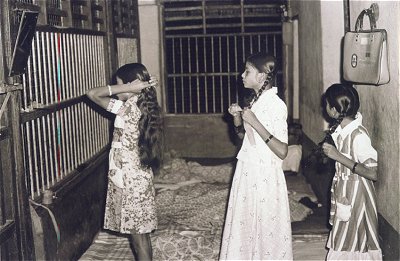
The following photograph taken in a Hindu Joint Family shows simultaneous sharing of a mirror by three girls. It is very early in the morning -- it is still dark outside, and you can see some family members still asleep in the background, on the floor. Notice the inclined poistion of the mirror (it is not straight) increasing its depth of view, which is allowing the girls have their own space of the mirror real estate.
Sometimes I am surprised at which of the content on this site people find interesting.
Examples:
The choice of yesterday's picture was
prompted by an elderly gentleman remembering the
photograph after 20 years. "Your father once took
a picture of three girls in front of a mirror. Do you have it?"
he asked, and I searched. I'd seen the picture before
and didn't think much of it. But for the gentleman to
remember it for so long, it must have meant something to him,
and when I studied the photograph, it made great sense to me.
I sometimes get admiration mail for my icons (shown on left toolbar).
If you like them, here are more.
Again, I didn't think much of my own icons, till someone else liked them.
Today I got a word of appreciation for a banner on our site. (Who said
people don't look at banners ?!) Although I didn't create the banner, I am reproducing it below. It's pretty cute, but I didn't notice it, till it was referenced.
You don't know how many people are interested in meeting this young girl my father photographed. Sorry fellas, the picture is old, and she's taken.
Sometimes the beauty is hidden, and unless someone
points it out to you, it is not visible.
Out of Stock Items on Sale
Business Wisdom from the Trenches
A businessman has written a thank you letter (yes, a letter, as in with paper and pen!) for the
business tip I gave on how to handle
more customers than you can, and asked for more such tips. So here it goes:
When you don't sell something, sell it for a song
My family has sold clothes for over a hundred years now, and it is mandatory
for boys of the family to serve an apprenticeship in the shop. This happened
when I was twelve years old - One villager bartered very hard to bring
down the price of a saree. He claimed that the same saree was being sold for a
lower price in a competitor's shop.
The Customer -- "Can you reduce the price of the saree to 30 bucks
please? That's the price in the other shop on the next street".
My uncle --"No Sir, they may appear same, but our product is of higher
quality. We sell it for 45 bucks to others, but since you are a regular
customer, I discounted it to 40"
Customer --"Can you reduce the price of the saree to 30 bucks
please? That's the price in the other shop on the next street".
My uncle -- "Why don't you buy it there then?"
Customer -- "He is out of stock today".
My uncle -- "Oh! When we are out of stock, we sell this saree for ten
bucks!!"
The article mentions of a Self-service Licensing page at Kamat's Potpourri. I've always encouraged fair use of our content, and I welcome the use of our pictures in blogs; credits and links are required, and no bandwidth theft please.
The writer of above mentioned article, Gopika Vaidya, in fact asked
me many other very good questions, and I am providing my answers below.
Q: Is all the content you post on your blog original? What does it comprise?
A: The stories and comments I post are original. The links I post are sometimes borrowed.
I use my blog to drive traffic to other contents on Kamat's Potpourri. I also write about my experiences and ideas I have had during the day.
Q: How would you react if someone were to copy or re-use the content on your web site/blog?
A:I resent copying of our content without providing credit, but welcome and encourage what is known as the "fair-use". I routinely provide permissions on re-use. I have even set-up a self-service request form for the purpose.
Q: Do you think original content on blogs and web sites should be protected by copyright? If so, why? A: From my understanding of the International Copyright Law, it is already covered, and rightly so. And the reasons are same as why printed or broadcast content is protected by the copyright law(to protect the intellectual works of the creator).
Q:Are you aware of your legal rights as a provider of original content on the web in India? If so, what according to you are your rights? A: To be honest with you, in India, we do not have a culture that recognizes and honors intellectual property. So the responsibilities and liabilities of content publishers in India far outweigh the rights. I am not aware of specific legal rights in India for web publishers.
Q: What sort of action would you take if you found that your copyright was being violated?
A: I have three pronged approach (ahimsa, threat, and then forgiveness )
First I try to reason with the violator of the wrong they are engaged in. I have had most reputed of Indian publishers copy our content from our website. When I tell them "All you had to do was ask, and I would have given you permission", they apologize and comply.
Second, I threaten them that I will go public with my complaint and usually write to the hosting company a legal letter. Since most hosting companies are in USA, they are bound to take action when a copyright holder writes a letter giving specifics of the violation and claims that he/she has been violated. This has worked well for me.
Finally, I take consolation that our work is reaching audience that we would not have otherwise reached.
While on the topic, I must mention a heartening development. These days, many of our readers in India now tell me when they notice copying of our content. This shows that readers in India not only care about originality, but also are particular about fair-use of intellectual property.
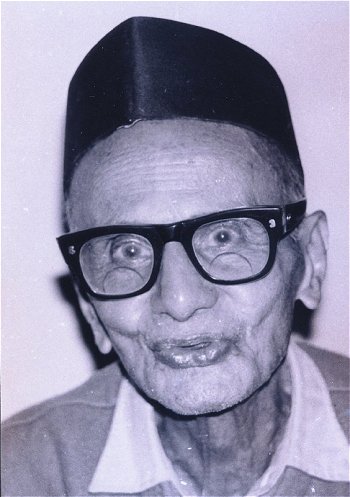
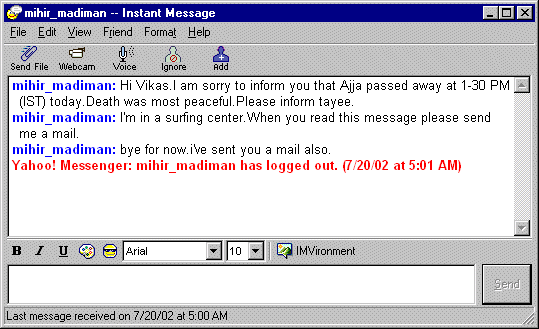
My maternal grandfather, Ganesh V. Burde passed away today in Bangalore. He was 97.
Ganesh V. Burde
1906 - 2002
Baba, as we affectionately called him, was a great influence on me as he was on my mother. He taught me English and tried very hard to cultivate reading habit in me. I attribute my grammar and sentence construction skills only to him, and only due to his efforts that I was able to compete with city bred, English-medium-educated students although I studied in an Indian language school till I was 15.
Baba had many other great qualities, one of which was his health. He didn't have any ailments (no arthritis, no blood pressure, no cancer, no heart ailment), and died purely due to old age. He was the most extraordinary scholar of Hindu scriptures I know and was a keen student of the Bhagawad-Gita, the Upanishads, the Sanskrit language, and of learning in general. At the age of 75 he took up learning a new language, Bengali -- He knew a total of nine languages including Urdu.
Baba is the only Hindu man I know who has read the Koran. He was well versed with the Bible as well, but led a very rational life sans rituals. During the India Freedom Movement, he sheltered the freedom fighters, although he himself was employed by the British Government. Since he could not get involved with the Indian National Congress, he had started a branch of the Arya Samaj to banish evil practices from the Hindu society. He'd attended Ambedkar's convention in Nasik to reform Indian society of the caste discrimination. He remained an agnostic till his death.
In Baba's death, we've lost a century's worth of history and knowledge.
Yesterday, in her blog, my mother silently busted an age-old, dark myth of
India that had denied the women the use of a sacred Hindu hymn.
The myth has to do with this five thousand year old mystical, powerful hymn
from ancient India called the Gayatri mantra. The hymn is always taught in
secret, mostly from father to his son, and never to a woman, or to a
person considered to be of "low birth".
I am not going to get into the magical, and divine prowess of the hymn, but
you can read and recite it on her blog.
I bet that most of those who chant the Gayatri mantra everyday, don't even
know its meaning, and will frown upon its use in a blog. Of course, those who
are sane amongst us will appreciate the succinct beauty of the hymn, and the
spiritual maturity of the Indians five thousand years ago. Those reformists
amongst us will admire the genius of Dayanand Saraswati (1824-1883), in
using this hymn to herald a social movement in India.
Rich Text Ads in Yahoo! Email
Like most people who read their personal email at work, I have turned
of viewing of embedded images in email messages so as to not accidentally get
into trouble. In fact, I have set up a message rule that flags such messages as risky-messages.
This morning I think Yahoo decided to insert rich
text advertisements (you know one with pictures and animation) in the email
messages people send via Yahoo mail, and a bunch of my emails were hence
flagged. Not a good development.
If Yahoo! wants to charge its users, or show advertisements to its users, I
have no problem, it is indeed their business. But as a recipient of an email
message, I am under no obligation to view the advertisement, and my Inbox rule
stays.
Color of the Night
The Color of the Night
We often tend to associate the color black with darkness, and hence with evil.
People who have black skin, naturally find this association offensive. Some years ago an artist with the TIME magazine used the black color to design a cover page on evil, and it lead to widespread protests by the African-American community.
In the following exhibit, I've tried to depict the color black (and the meaning of it) in some new perspectives: as the color of Lord Krishna, as the color of the Monsoons, as the color of the mighty Goddess, and as the color of the elephants.
The first in the series of Blue, Green, Red, and Black:
If you are wondering how much time I spent making the blog entry above -- you know, stubbing the pictures, linking the captions, formatting, etc., the answer is less than a minute. Yes, less than a minute, because the Kamat Blogging Engine supports SQL, and I wrote a macro as follows:
[[PicTOC SQL=Select * from ScannedPictures where Instr(Destination, '/black/') >0 ]]
Then Anita Bora started a much longer list, with annotations and locations.
Her list has grown a lot, and alphabetization, while helpful, doesn't suffice the need to browse through it rapidly.
We need a tool that does the following: • Search by name of the blog or blogger (the person who writes it) • Search by location (which part of India, outside of India etc.) • Sort by most oftenly updated or alphabetically • List the blogs by most recently updated
I hear that some work is being done by Mahesh Shantaram and Anita, and I look forward to its release.
I wish I still had my spider Narad active, so we could have summarized the recent entries.
Tips for the Implementor(s)
To avail the time of most recent update, we can use the Last-modified tag provided by the HTTP header. While many servers may not provide it (and it might be incorrect for the dynamically generated blogs, like my AutoBlog), it is a cheap way to fetch the time of last update.
Alternately, we can implement a Weblogs.com like ping interface. Upon updating their blog, the bloggers would have to tell the portal that they have updated the blog.
Blog Portal
More Details on the Blog Portal
After yesterday's exchange of ideas on building a Blog Portal, Mahesh sent a message
that my ideas are too ambitious. Perhaps they are, but I still feel we should do it.
I went ahead and created the following database table.
Most fields are self-explanatory. LastPing and LastFetch would indicate the time of last ping ("You call me") and
the time of last retrieve by the spider ("I'll call you"). PublishYes is the flag that must be set by the editor in approval for inclusion. This is necessary to prevent abuse. PrivateComments are only for internal use
explaining why an entry was rejected. I have added a comma separated keyword field so that the blogs
can be catagorized. Annotation is provided by the author and is modified by the editor for clarity.
IMO, the alphabetical list of blogs is of little use. We never browse books in a library alphabetically
nor are the groceries arranged by names. Further, alphabetical listings provide unfair advantage to blogs starting with the letter "A"; examples are AnthoBLOGy and Amma's Column, . Relevance and context is much more
important than the names. Anyway...
We must have search facility that would search any of the fields (except private comments), so by searching
Mumbai, you not only find blogs blogged from Mumbai, but also on Mumbai.
Still undecided issues: • "You ping me, I will ping them" -- a broadcast service for Indian bloggers? • The location of the Directory (considering www.kamat.org/community or blogs.kamat.com) • Who will be the editors?
Severe Shortage of Eyes in India
Eye banks typically accept eyes
only when the deceased donor was under 75 years of age. But the shortage of eyes is
so severe in India that my grandfather's 97 year old eyes (see obituary) were delightfully
accepted and will be grafted on two different individuals (eye recipients are
allowed only one eye in India due to shortage).
The Lion's Club which runs an eye foundation in the city of Bangalore has honored my family for the leadership (my father also donated his eyes) and creating public awareness about eye donation. Personally, for me there is no greater joy than to know that we can serve fellow humans even in our death.
Powered NOT by Blogger or MovabaleType or
WordPress, but by SimplyBlog, a software I wrote to
create blogs.
See details
of implementation or download SimplyBlog.
This is how I surf the web. Turns out
creating your own start page beats all portals, back-flipping,
personalized corporate pages, and book-marking tools.