


Chanakya or Koutilya is credited with authorship of Arthashatra, an authoritative text on polity and statecraft. Over centuries, smritis or codes on similar subjects quoted Koutilya profusely, but the original text was long lost.
When R. Shamashastry who was the librarian of Oriental Library in Mysore found a copy of the sanskir text of Arthashatra in a palm-leaf book, edited, and brought out an English version in 1909, it created waves in the western world. Till then Machiavelli's "Prince" (15th century ) was considered a master-piece on state-craft. But here was a manual for running the state efficiently in all the branches, legislature, executive, and judiciary, written hundreds of years earlier! Arthashastra also gave importance to military science. Acquisition of wealth, and its management which we now call in narrow sense of artha, had prime importance to include polity. Hence the work is called Arthashastra.
According to ancient Indian texts, among four human goals to be achieved dharma, artha, kama, and moksha, artha is next only to dharma or virtuous living the other two being desire, and liberation). It only shows that acquiring wealth and its efficient management was most important both for the individual and the state. Arthashastra in wider sense includes niti (polity), danda (administration) and management of resources and its constant seeking (anvikshana).
Kautilya was the prime-minister of emperor Chandragupta Maurya who was the grandfather of Ashoka the great. He rules in the fourth century B.C. Arthashatra as conceived by Kautilya thus stands for acquisition of state wealth, its protection besides overall governance of a region or state. Considering that Mauryan empire included the vast Indian subcontinent including present day Pakistan and parts of Afghanistan, Kautilya's vision of a welfare state is admirable. Such a vast region could be controlled by only an efficiently run military force with central system of governance with due powers to local self-governed agencies, suited contemporary India.
Very soon, Arthashastra was translated into French, German, and other European languages. It began to be discussed avidly in learned assemblies. An interesting event happened during the visit of Narasimharaja Wodeyar, the prince of Mysore in Western Europe. At a party befitting the royal dignitary, several well known scholars and indologists were invited. When the prince was introduced to a German scholar, he exclaimed, "You are from Mysore? The great Shamashastry's kingdom?" The royal member nodded with dignity, unaware of the immense popularity the discoverer of Arthashastra had enjoyed abroad.
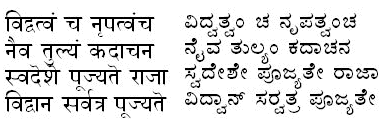
Upon his return to Mysore, the prince arranged for a public felicitation for R.Shamasastry, and the great scholar was honored. The price rightly lived up to the adage:
"Royalty and learning can never be compared. The king is revered only in his country. The scholar is revered everywhere"

• Wisdoms of Chanakya
• Span of the Mauryan empire
• Emperor Ashoka and the spread of Buddhism
• The Wodeyars of Mysore