


From Hanuman to Raghavendra: A Remarkable Madhva Connection
While looking into Madhvacharya and Raghavendra Swami, I came across a remarkable connection involving three very familiar figures: Hanuman, Bhima and Madhvacharya.
The connection begins with Vayu, the Wind God, or Mukhyapra?a, whom the Madhva tradition regards as the divine life principle and an important servant of Lord Vishnu.
According to the traditional Madhva understanding, Vayu manifests in three great forms across the yugas.
In the Treta Yuga, he appears as Hanuman, the incomparable devotee and servant of Lord Rama. Hanuman's enormous strength has meaning because it is completely dedicated to Rama.
In the Dvapara Yuga, Vayu appears as Bhima, the mighty Pandava. Bhima's strength once again becomes an instrument of divine service—this time in the age of Lord Krishna.
And in the Kali Yuga, the tradition identifies Vayu with Madhvacharya, the great philosopher who established Dvaita Vedanta.
The three therefore form a fascinating spiritual sequence:
Hanuman  Bhima Madhvacharya
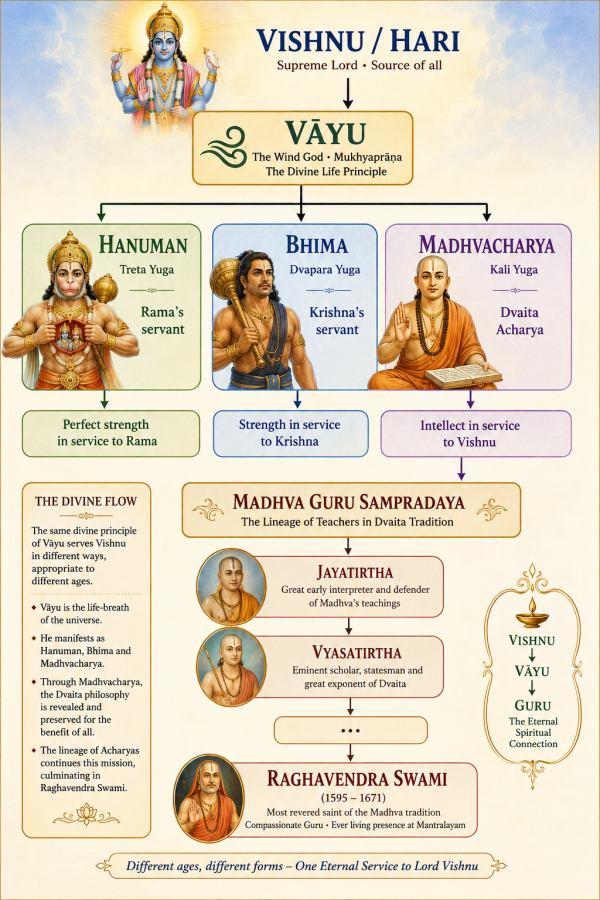
Madhvacharya was not merely a philosopher. He established a powerful intellectual and devotional tradition centered on the supremacy of Vishnu and the eternal distinction between God and the individual soul. His teachings became the foundation of what is now known as the Madhva Sampradaya.
And this is where Raghavendra Swami enters the story.
Raghavendra Tirtha lived nearly three centuries after Madhvacharya (from 1595 to 1671). He was a brilliant scholar and teacher in the Madhva tradition and became one of its most beloved saints.
The connection between Madhvacharya and Raghavendra is therefore not that they were teacher and pupil. Rather, Raghavendra stands much later in the **guru tradition that preserved, defended and developed Madhvacharya's teachings**.
This gives us two different kinds of continuity.
The first is the traditional divine connection:
Vayu ? Hanuman ? Bhima ? Madhvacharya
The second is the human lineage of teachers:
Madhvacharya generations of Madhva acharyas Raghavendra Swami
And at the center of both is Vishnu/Hari. This way of looking at the tradition also gives a beautiful interpretation to the three manifestations of Vayu.
Hanuman represents strength in service.
Bhima represents strength in action.
Madhvacharya represents intellect in service of God.
And Raghavendra Swami represents the continuation of that teaching and devotion through the guru tradition.
At Mantralayam, where Raghavendra Swami's Brindavana has become one of the great pilgrimage centers of the Madhva tradition, this centuries-old connection remains very much alive.
Whether one approaches these stories as matters of faith, philosophy, history, or mythology, they reveal something characteristic of Indian civilization: **ideas are rarely isolated. They travel through teachers, stories, temples, poetry and living traditions, connecting people separated by centuries.**
For me, the most beautiful part of the story is the underlying idea:
Different ages. Different forms. Different roles.
One eternal service to Lord Vishnu.


