


Remembering Jyotsna as a Colleague
by Krishnamurthy Hugoppalu
Presented at Kamat Samsmarane 2025, January 2025.
Page Last Updated: September 03, 2026
This is a wonderfully rich and historically significant Kannada narrative about Dr. Jyotsna Kamat's tenure at Mysore Akashvani (All India Radio), as experienced and witnessed by a colleague. Here's an English translation based on the Kannada Original (pdf). Created using expeminental AI.
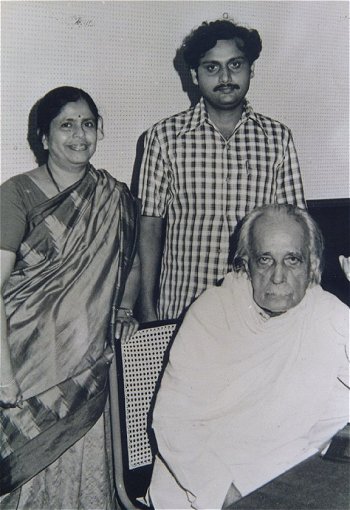
The Author with Jyotsna Kamat and Shivaram Karanth
Akashavani, Mysuru
Dr. Jyotsna Kamat at Akashvani Mysore
I had the privilege of working under Dr. Jyotsna Kamat at Akashvani (All India Radio), Mysore, from 1983 for three years. Those remain some of the most valuable days of my professional career.
She had a long tenure with Akashvani, serving in various roles such as Program Executive, Assistant Director, Director, and Station Director SG. She began her career in Dharwad, and later served in Jaipur (Rajasthan), Bengaluru, Kolkata, Mysore, and Mumbai. Since I only worked with her in Mysore, I will speak exclusively about what I personally witnessed during that time.
A Sudden Arrival and an Immediate Challenge
She arrived from Bengaluru by train and, without any official transport arranged (since she hadn't requested it), took an auto-rickshaw directly to the station. Just moments later, a group of Mysore's senior litterateurs including H. S. Krishnaswamy Iyengar (HSK) and Prabhushankar came to meet the Station Director—not to welcome her, but to protest AIR's policy of treating Mysore Akashvani as a mere relay center of Bengaluru or Delhi.
When they learned that the new Director was Krishnanand Kamat's wife, they returned, hopeful of change.
Program Revamp and Local Empowerment
From the very beginning, Dr. Jyotsna Kamat was action-oriented. She worked closely with the then-head of Engineering, Sundarakrishnan, to reduce the number of relays and increase original content production. Despite limited staff and recording machines, she secured approval from Delhi to expand local programming.
Instead of broadcasting one drama every three months, two were aired every month. Broadcasts of music, radio plays, interviews, and literary programs all increased. Live music programs replaced gramophone-based ones—an intelligent move since they didn't require recording equipment. This opened up opportunities for local musicians, dramatists, and writers.
Encouraging Talent and Initiative
Though staff was limited, everyone contributed enthusiastically. Dr. Kamat had the knack for identifying people's strengths and encouraging them accordingly—whether announcers, duty officers, or producers.
Of the three Program Officers at that time:
-
Thyagarajan handled music
-
I (the author) handled drama, radio features, Yuvavani (youth programs), and all spoken-word content
-
Sriram Bharti, who didn't know Kannada, managed program coordination
We often worked from 8 AM to 9 PM.
Her first act was buying a Kannada typewriter so artists and speakers could be communicated with in Kannada. This was a blessing for me since I wasn't confident in English. Our Telugu-speaking secretary, Ratnabai, was excellent at Kannada typing.
Unlike typical AIR Directors who required prior approval for any external collaboration, Dr. Kamat allowed us to take initiative. She appreciated good work and rarely objected once something was committed. This gave us confidence and freedom to discover and promote new talent, many of whom are now renowned in Kannada media.
Some examples:
-
Nagathihalli Chandrashekar
-
M. Krishnegowda
-
Ranjan Darga, Mogalli Ganesh, Rasheed, Niranjan Vanalli
-
Nemichandra, who was then a youth storyteller, now a prominent public speaker
Rebuilding the Bridge with Kuvempu
At the time Dr. Kamat took charge, the legendary poet Kuvempu had boycotted Akashvani for years after a line from one of his poems was edited out without his permission. Even after official apologies, he refused to return.
Using her personal rapport as Krishnanand Kamat's wife, she managed to get an appointment and met Kuvempu at his home—I accompanied her. Initially, he didn't agree to any collaboration. Then she played her trump card:
"Sir, we would like to compose and broadcast Vishwamanava Geethe (Universal Man's Anthem) with a new musical arrangement and group performance. Your blessing—and ideally your voice—would make it invaluable."
Kuvempu melted.
The day he returned to Akashvani was one of celebration. Later, several interviews and recordings were done for archival purposes with Dejagow, Prabhushankar, and Sujana. We recorded his nature poems, revolutionary verses, and Kannada-centric works in multiple episodes.
He even participated in Mysore AIR's Golden Jubilee special audience program.
One major hurdle was that his epic "Ramayana Darshanam" couldn't be aired since AIR's contract only allowed for poetic renditions, and Kuvempu didn't accept it as just a poem.
Dr. Kamat resolved this by negotiating with senior Kannada officer Vasantha Kumari in Delhi and secured a significant royalty contract for the entire epic. Only then was it broadcast across AIR centers.
All India Radio/Kamat's Potpourri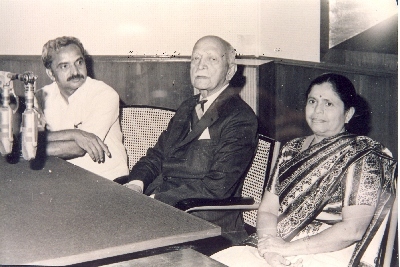
Ananthamurthy, Field Marshal Cariappa, and Jyotsna Kamat
All India Radio Mysore, circa 1986
Preserving Kannada Literary Heritage
As a historian, Dr. Kamat was passionate about documentation. Under her leadership, AIR Mysore recorded archival interviews with literary stalwarts like:
-
Putina
-
R.K. Narayan
-
Dejagow
-
A.N. Moorthy Rao
-
Prof. Venkataramappa
-
Tarasu
-
TaSu Shamarao
-
Agaram Rangaiah
-
M.N. Jois
-
Field Marshal K.M. Cariappa
Unfortunately, due to inadequate library ventilation and preservation facilities, some of these priceless magnetic tape recordings have been lost.
All India Radio/Kamat's Potpourri
Ananthamurthy, Field Marshal Cariappa, and Jyotsna Kamat
All India Radio Mysore, circa 1986
Legacy
Dr. Jyotsna Kamat's tenure at Mysore Akashvani marked a transformational era. From encouraging young talent to reviving ties with literary giants like Kuvempu, she redefined what a station could be.
Her contributions continue to echo in Kannada broadcasting history.
